

Hero photo: Jakub Żerdzicki / Unsplash. Illustrative currency and budget planning.
Currency hedging for importers starts with the purchase order: which currency is owed, how much is due, and when payment must arrive. A fixed euro invoice can still produce a changing dollar cost until the exchange rate is settled.
The objective is a purchasing budget the business can work with. Begin with the exposure, then compare the available ways to manage it.
Map the currency risk in your orders
Identify the payment currency
Foreign exchange risk for importers arises when the business must buy currency to settle a bill. A US business owing euros generally needs more dollars if the euro strengthens against the dollar before conversion. Review the agreed currency in your vendor contracts and payment terms.
Separate committed orders from forecasts
An accepted invoice and a possible future order have different levels of certainty. Record deposits, balances, expected payment dates, and cancellation rights so currency risk for importers is tied to actual obligations.
By the numbers
$9.5TDaily global OTC FX turnoverApril 202527%Increase in daily turnover
Versus April 2022
Source: BIS Quarterly Review, December 2025. Market-wide turnover; not importer savings or a forecast.
Compare natural hedging and financial contracts
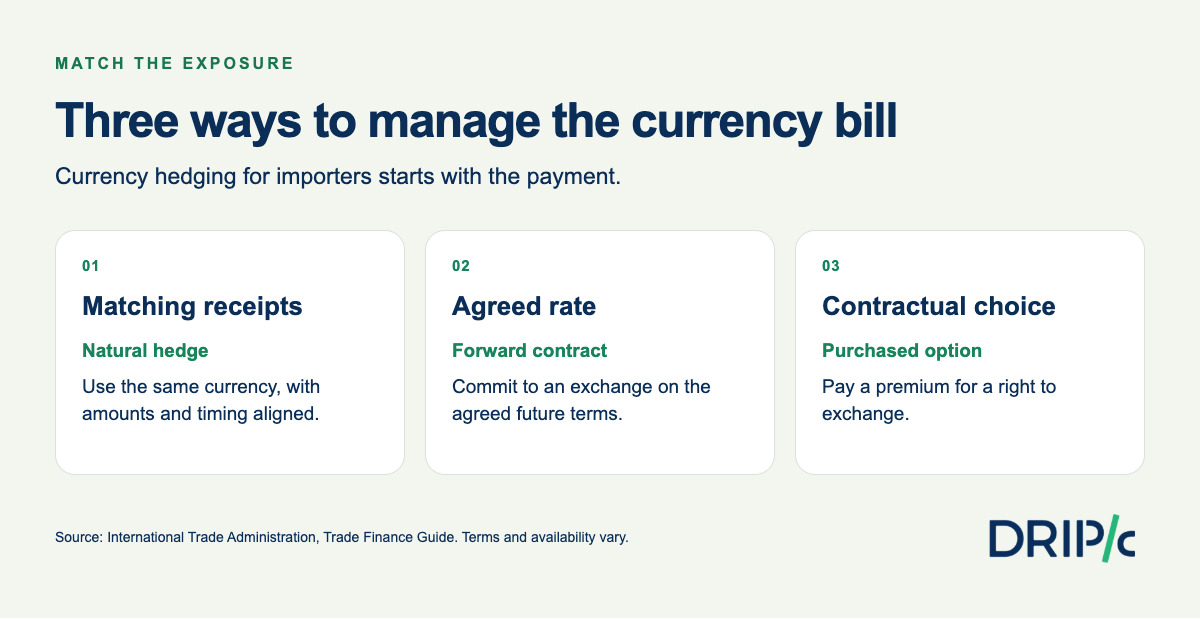
The International Trade Administration's guide explains matching currency receipts and payments, forwards, and purchased options. The same mechanisms can be applied to an importer's currency purchases.
Match receipts with payments
Natural hedging uses incoming foreign currency to meet expenses in that currency. Timing and amount must align: expected receipts that arrive after a vendor deadline leave a cash gap. This is a practical starting point for foreign exchange risk management when the business both imports and exports.
Agree a forward exchange rate
A forward contract for importers fixes the rate for an agreed currency purchase on agreed future terms. The purchase obligation continues even if the underlying shipment is delayed or canceled. Our forward-contract guide explains the instrument in more detail.
Buy an option
A purchased currency option gives a contractual right to exchange at its specified rate, subject to its exercise terms. The buyer pays a premium and can retain access to a more favorable market rate. The premium belongs in the comparison.
A worked import-payment example
Assume an importer owes €100,000 in 60 days. At an illustrative budget rate of $1.10 per euro, the planned payment is $110,000.
| Payment scenario | Dollar amount |
|---|---|
| Unhedged: euro rises to $1.15 | $115,000 |
| Unhedged: euro falls to $1.05 | $105,000 |
| Entire invoice hedged at an assumed $1.11 forward rate | $111,000 |
The forward fixes the modeled currency cost: $4,000 below the first spot scenario and $6,000 above the second. These are hypothetical rates; provider charges and other transaction costs are excluded. No outcome is a forecast.

Hedging import payments also requires cash on the settlement date. Add that obligation to your cash-flow forecast, together with freight, duties, payroll, and financing repayments.
What to check before agreeing a hedge
Settlement and cancellation
Ask how early, late, partial, or canceled payments are handled and priced. A replacement order may have a different currency or date. Managing exchange rate risk includes reviewing the contract when the purchase changes.
Cash and credit requirements
Confirm any deposit, collateral, credit-line, or margin requirements with the provider. Forward contracts also create counterparty default risk. Availability and terms vary by business and instrument.
A consistent approval process
For FX hedging for importers, assign responsibility for approving amounts, checking confirmations, and reconciling settlements. Keep the purchase record, hedge confirmation, and payment evidence together. This operating discipline is part of cash-flow management.
Choosing a method for the purchase
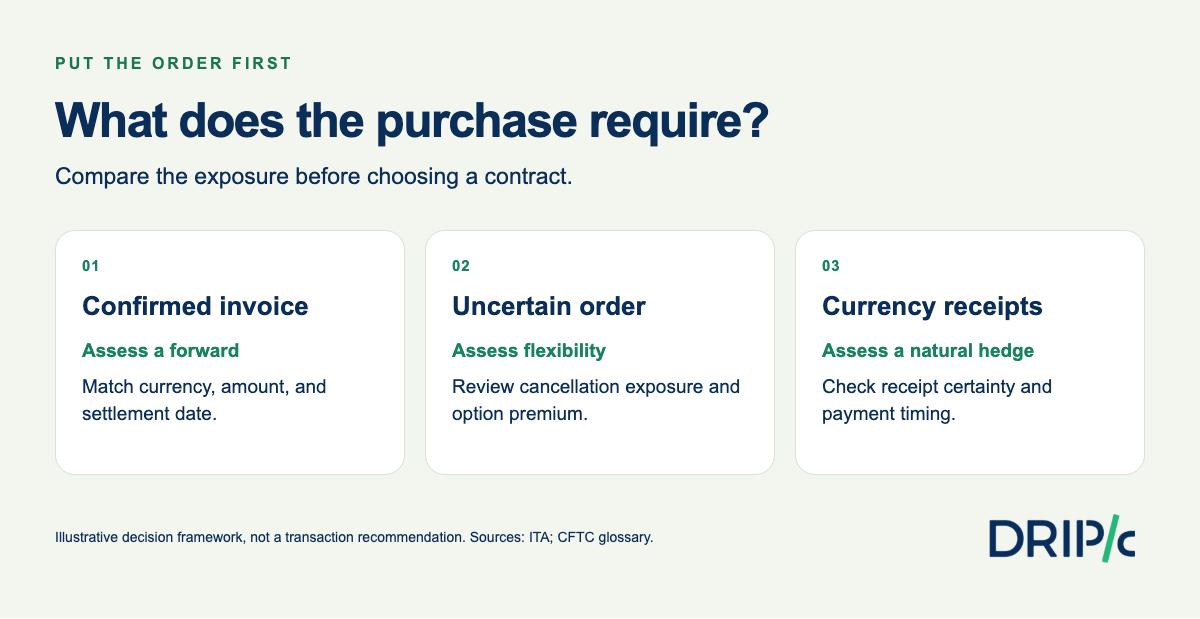
Currency hedging for importers should reflect the purchase. When comparing natural hedging vs forward contracts, start with currency receipts already available. Then assess the remaining exposure, the certainty of the order, and the business's capacity to meet the contract.
Learning how to hedge currency risk means understanding both the exchange-rate protection and the obligations created. Review the specific transaction with a qualified FX provider; an exchange-rate view alone is a weak basis for a purchase-payment plan.
Coordinating vendor payments with Drip Capital
Drip Capital's [Vendor Financing](https://www.dripcapital.com/en-us/resources/finance-guides/vendor-financing) pays vendors directly, with repayment terms of up to 90 days, subject to approval and agreed terms. Discuss the payment currency and timing before arranging funding.
Keep any FX hedge and its settlement requirements coordinated with that financing. A financing agreement by itself should not be treated as an exchange-rate guarantee.
Frequently asked questions
Does a forward guarantee the lowest dollar cost?
It fixes the exchange rate under the agreed terms. A later favorable market move can make an unhedged payment cheaper in hindsight.
Can a business hedge an order that is still uncertain?
Products and provider terms differ. A binding forward can leave an obligation if the order never happens, so assess that risk before committing.
Does invoicing in dollars remove all currency exposure?
A fixed dollar invoice removes the need to buy foreign currency for that payment. Vendors may still change future dollar prices as their own currency costs move.
Does financing replace currency hedging?
Financing addresses payment funding and repayment timing. Exchange-rate protection requires its own assessment of the currency exposure and any hedge contract.