

Photo: Arpit Rastogi / Unsplash. Illustrative image.
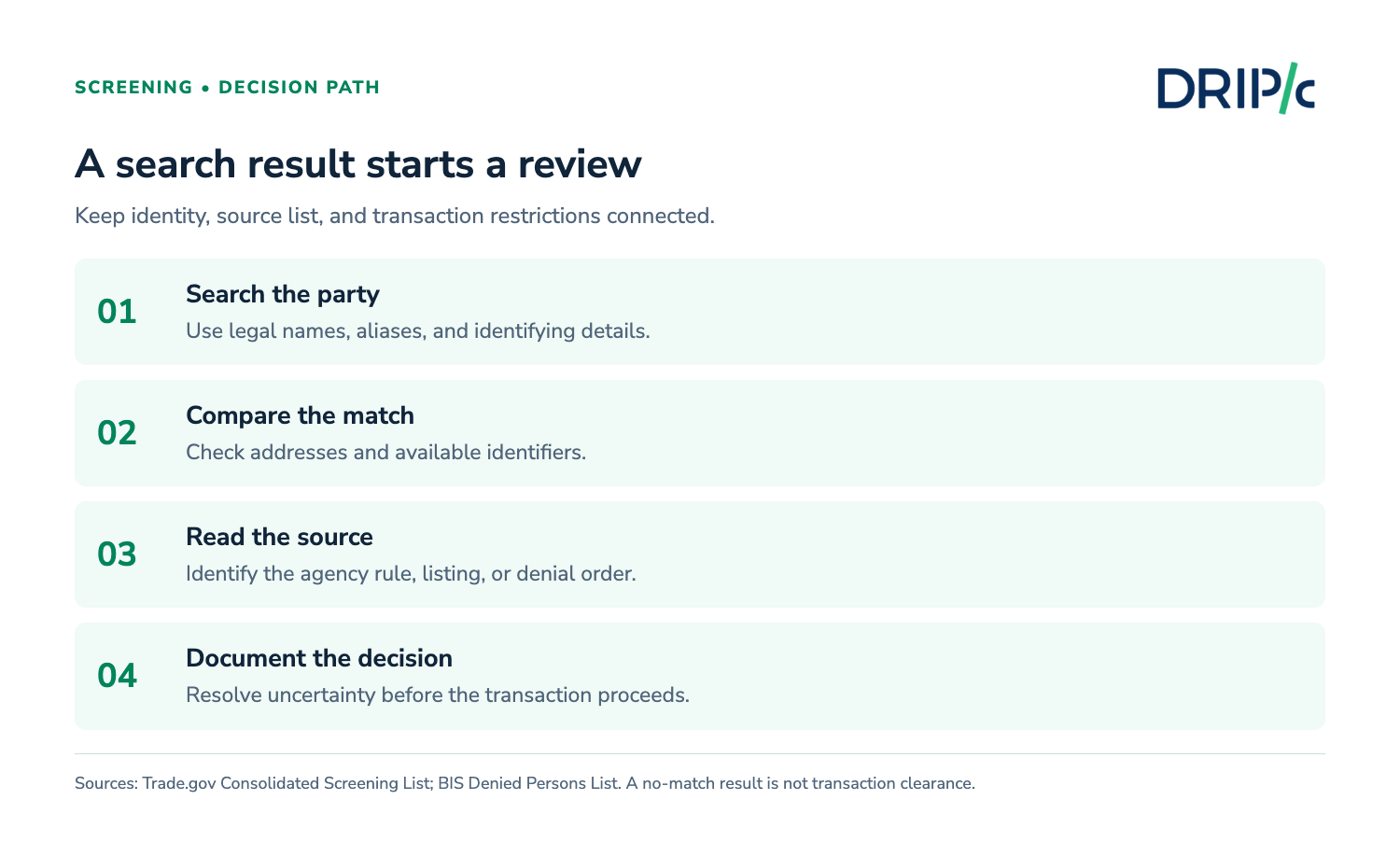
A screening search returns a name that resembles your customer's. The result needs a closer look: which list produced the match, whether it identifies the same party, and what restriction applies.
Businesses often use denied parties list as a broad phrase for trade screening. In practice, several government lists serve different purposes. Understanding those differences helps a team handle a possible match without guessing.
What is the Denied Persons List?
The Bureau of Industry and Security's Denied Persons List identifies parties denied export privileges under the Export Administration Regulations. The applicable denial order sets the restrictions and relevant dates.
Read the order behind the listing
The order is the controlling source for a listed party's restrictions. Check the activities covered, effective period, and any qualifications. A familiar customer name or an old screening result cannot establish today's position.
Distinguish the other lists
The Entity List can impose additional license requirements. The Unverified List signals a different set of requirements. Treasury sanctions lists and State Department restrictions have their own legal bases. The Consolidated Screening List overview explains these sources and directs users to the underlying agency records.
A restricted party screening workflow should preserve that distinction instead of labeling every result “banned.”
Where to start a denied parties list search
The government's Consolidated Screening List, or CSL, combines multiple Commerce, State, and Treasury lists. Its search supports names, countries, source agencies, and fuzzy matching.
Collect the identity first
Gather the legal business name, trading names, address, country, and relevant identifiers. Identify the buyer, consignee, end user, and other parties involved in the transaction. Keep the information tied to the order being reviewed.
A commercial invoice can provide some details, but gaps and inconsistent names need follow-up.
Search more than one spelling
Use known aliases and alternate spellings where relevant. A fuzzy match is a lead for investigation. Its score does not decide whether the transaction may proceed.
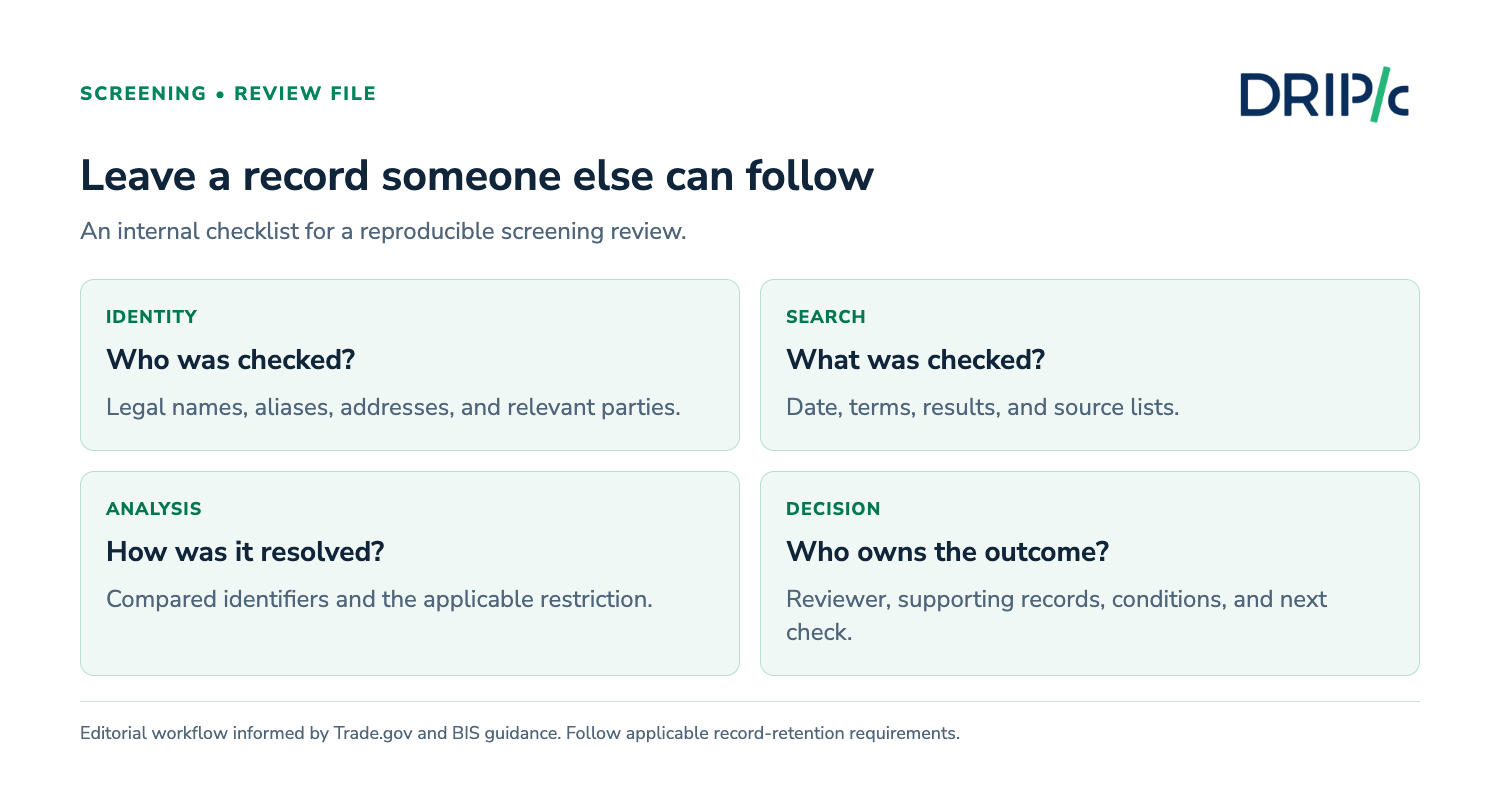
Record the search date, search terms, result, and source list so someone else can reproduce the review.
By the numbers
Daily refresh: Trade.gov says its CSL tools update daily at 5:00 AM Eastern, depending on source-agency updates. Check the underlying source before relying on a result.
50% ownership: Under OFAC's 50 Percent Rule, certain entities owned directly or indirectly, 50% or more in aggregate by blocked persons, are themselves blocked. Ownership review can matter even when a name does not appear in a search.
What to do with a possible match
Compare identifiers and resolve uncertainty
Compare addresses, aliases, identification numbers, and any other available distinguishing information. A similar name may identify an unrelated business. Conversely, a different spelling can still refer to the same party.
For example, a hypothetical search for “Harbor Components” might return a similarly named company in another city. Save the evidence supporting any conclusion. A sales contact's assurance alone leaves the comparison incomplete.
Escalate before committing the transaction
Route an unresolved match to the person responsible for compliance. The US export-controls overview explains the broader controls that may apply alongside screening.

Make the review status visible to sales, purchasing, finance, and shipping. A practical internal status such as “review pending” helps prevent one team from releasing a payment or shipment while another is still investigating.
Keep a decision record
Capture the source order or agency entry, the identifiers compared, the reviewer, and the reason for the decision. If authorization is required, retain it and its conditions with the transaction file. Ask your compliance adviser which record-retention rules apply.
Connect the outcome to the vendor agreement and shipment references so the decision remains traceable.
Why a clean search is only one check
Product, destination, and use still matter
A transaction can require a license because of the item, destination, end use, or end user even without a listed-name match. Use the ECCN guide and EAR99 explanation to understand the classification questions that sit alongside screening.
An EAR99 classification does not create blanket permission for every customer or destination.
Review changes before release
Build a practical re-screening policy around your transaction cycle and risk assessment. Changes in the consignee, bank, destination, ownership, or government lists can warrant another review. Avoid treating a check performed months ago as a permanent clearance.
The export and import license guide provides broader context. The current agency rule or order determines the actual requirement.
Where Drip Capital fits into the payment process
Once the business has established that a proposed transaction may proceed, it can assess payment timing separately. Drip Capital's Vendor Financing pays vendors directly, with repayment terms of up to 90 days, subject to underwriting, transaction review, and agreed terms.
A financing decision does not replace restricted-party checks or government authorization. Keep payment instructions and the compliance decision connected in your internal workflow.
Frequently asked questions
Are the Denied Persons List and Entity List the same?
No. They have different purposes and restrictions. Review the relevant denial order or Entity List entry and the applicable rules before deciding what a result means.
Does a similar name prove a match?
No. Compare identifying details and resolve uncertainty through the compliance process. Keep the evidence supporting the decision, including the underlying source.
Does no match mean an export is permitted?
No. Classification, destination, end-use controls, ownership, and other restrictions can still matter. Screening is one part of the transaction review.
Should existing customers be screened again?
A relationship can change, and government restrictions can change. Set re-screening triggers and frequency through the business's compliance program, including checks when relevant transaction details change.