

Hero photo: The Retro Store / Unsplash. Illustrative order packing in Glasgow.
Ecommerce working capital supports the everyday costs of running an online store: inventory, fulfillment, advertising, payroll, and refunds. The amount you need changes with reorder dates, sales speed, and when money reaches your bank account.
A useful ecommerce working capital plan follows those cash movements week by week. It helps answer a practical question: can the business pay for its next order while the current stock is still selling?
What working capital means for an online store
The SEC defines working capital as current assets minus current liabilities. Inventory can count as a current asset, but it still needs to sell before it produces cash.
Profit and available cash follow different clocks
Positive margins can coexist with a temporary cash shortage. Working capital for ecommerce has to cover the interval between paying for goods and collecting spendable proceeds, including returns and operating costs.
By the numbers
$340.2BUS retail ecommerce salesQ2 202617.1%Share of total retail sales
Q2 2026
Source: US Census Bureau. Seasonally adjusted estimates; sales are not adjusted for price changes.
Build a weekly cash forecast
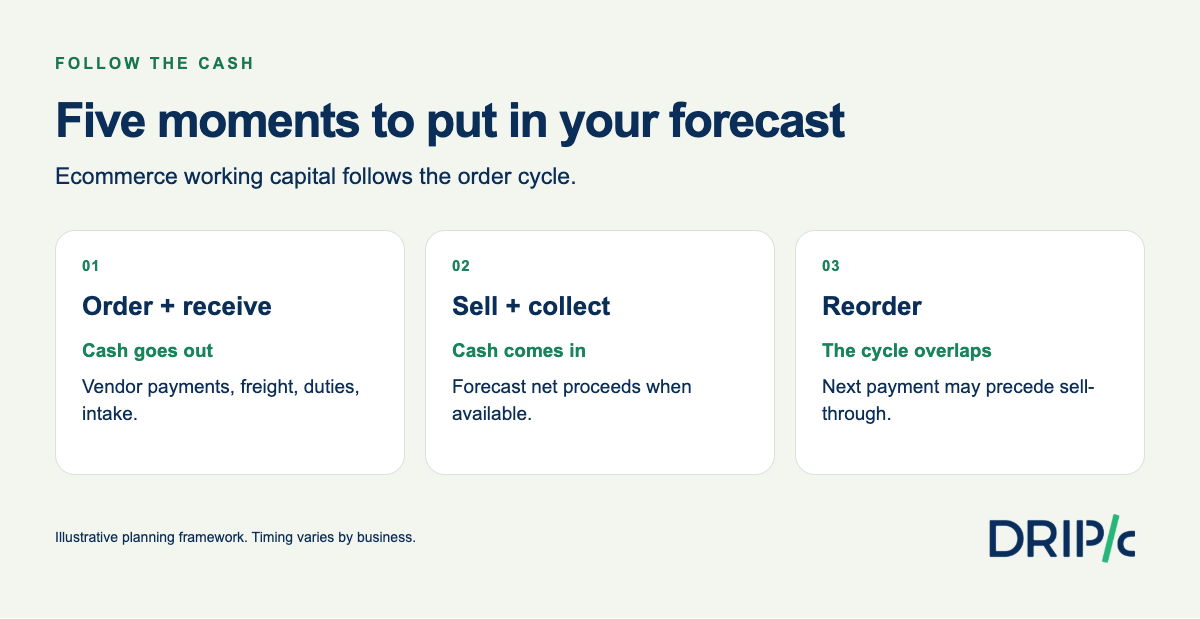
Start with unrestricted cash, add expected receipts, and subtract payments by their actual due dates. This turns online store working capital into a calendar you can update as orders change.
Map inventory payments
Record deposits, final vendor payments, freight, duties, and fulfillment intake costs. Review vendor payment terms alongside reorder lead times. A reorder can fall due before the previous batch has sold through.
Include operating expenses
Add payroll, advertising, software, shipping, refunds, taxes, and debt payments. Budget a cash cushion for slower sales or higher returns. Working capital for online retailers needs to cover the whole operating cycle.
Use realistic collection dates
Model when net proceeds are available, allowing for platform deductions, payout timing, and possible reserves. For marketplace-specific mechanics, see the Amazon seller financing guide.
Calculate the funding gap
Here is an illustrative forecast for one inventory cycle. Assume the business starts with $30,000 available and receives the modeled $45,000 only after the expenses below.
| Cash movement | Amount |
|---|---|
| Opening cash | $30,000 |
| Inventory payment | −$40,000 |
| Freight and duties | −$8,000 |
| Operating expenses | −$12,000 |
| Balance before sales receipts | −$30,000 |
| Later net sales receipts | +$45,000 |
| Ending balance | $15,000 |
The business needs $30,000 to bridge its lowest cash point. Maintaining a separate $10,000 minimum cushion raises the modeled funding need to $40,000. Actual results depend on payment sequencing, collections, financing costs, and repayments.

Repeat the forecast with slower sales and delayed receipts. This is the foundation of ecommerce cash flow financing: size the facility around the largest expected shortfall and check that repayments fit the recovery.
Match financing to the expense
Vendor payments
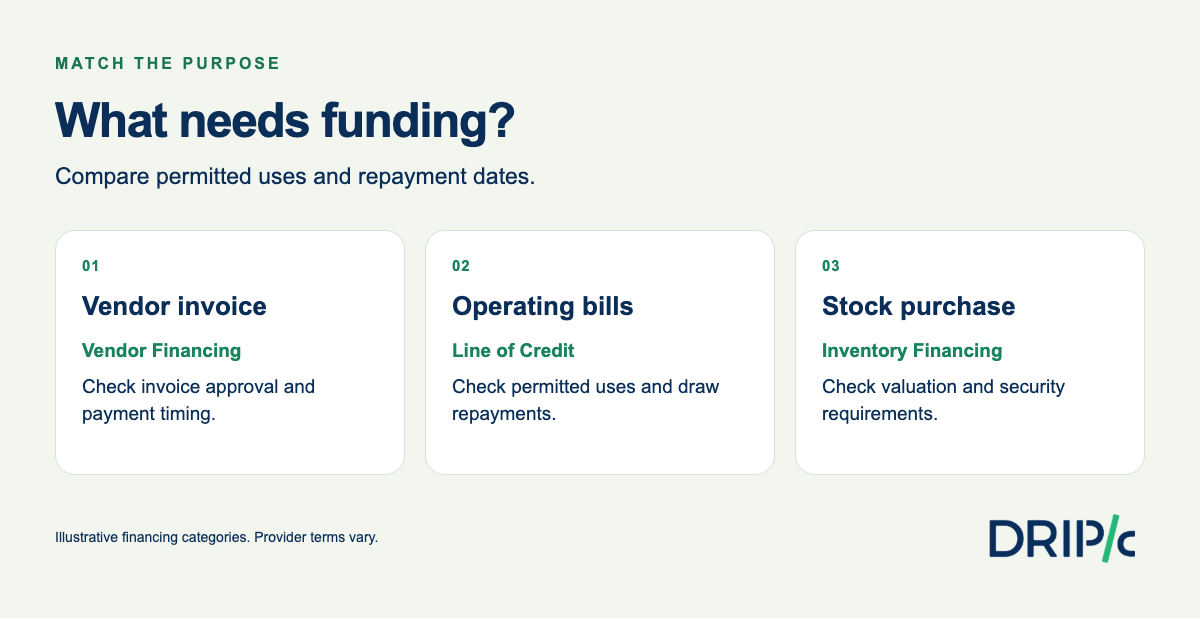
Vendor Financing can address an invoice due before sales receipts arrive. When assessing funding for ecommerce businesses, confirm who receives the funds, which invoices qualify, and the repayment dates. Negotiate commercial terms with the vendor as well.
Mixed operating costs
A Line of Credit can offer revolving access for changing expenses, subject to its terms. Compare draw costs, repayment frequency, and permitted uses. Working capital loans for online sellers can also provide a defined amount and repayment schedule; this working capital loan guide explains the mechanics.
Stock purchases
Ecommerce inventory financing may fit businesses whose main constraint is buying stock. Review inventory eligibility, valuation, security requirements, and total cost. The Inventory Financing guide covers that structure in more detail.
Good ecommerce business financing should fit both the expense and the collection cycle. Include financing costs in product margins and test whether the business can repay if a launch underperforms.
Ecommerce working capital with Drip Capital
Drip Capital's Vendor Financing pays vendors directly, with repayment terms of up to 90 days. Its Line of Credit offers revolving access; each draw is repaid over six monthly installments. Approval and agreed terms apply.
Bring your vendor invoices and cash forecast to the discussion so the financing can be assessed against the purchase and repayment timeline.
Frequently asked questions
How much ecommerce working capital do I need?
Calculate the largest projected cash shortfall and add your chosen minimum cushion. Update the forecast for seasonality, returns, and repayment obligations.
How do I fund an ecommerce business with uneven sales?
Start by mapping expenses and realistic collection dates. When deciding how to fund an ecommerce business, compare vendor terms, retained cash, and financing against that forecast.
Can financing cover advertising and payroll?
Some facilities permit these operating uses. Confirm the agreement's restrictions before drawing funds; invoice-specific financing can have a narrower purpose.
Will higher sales automatically improve cash flow?
Growth may require more inventory and marketing spending before receipts arrive. Recalculate the cash gap whenever order volume or reorder timing changes.