

Photo: Ritul Bhattacharjee. Illustrative image.
You ask a factory for 200 units. The quote comes back with a minimum of 1,000. The unit price looks good, but now you need to sell five times as much stock as you planned.
That is why understanding MOQ meaning matters before negotiating price. The minimum changes your total cash commitment, your storage needs, and the time it may take to recover your money. You can sometimes negotiate it, especially when you understand what is driving it.
What does MOQ mean?
MOQ stands for minimum order quantity: the smallest quantity a vendor agrees to sell under specified terms. Alibaba's seller guidance describes it as a commercial minimum set for an order. The exact condition depends on the quote.
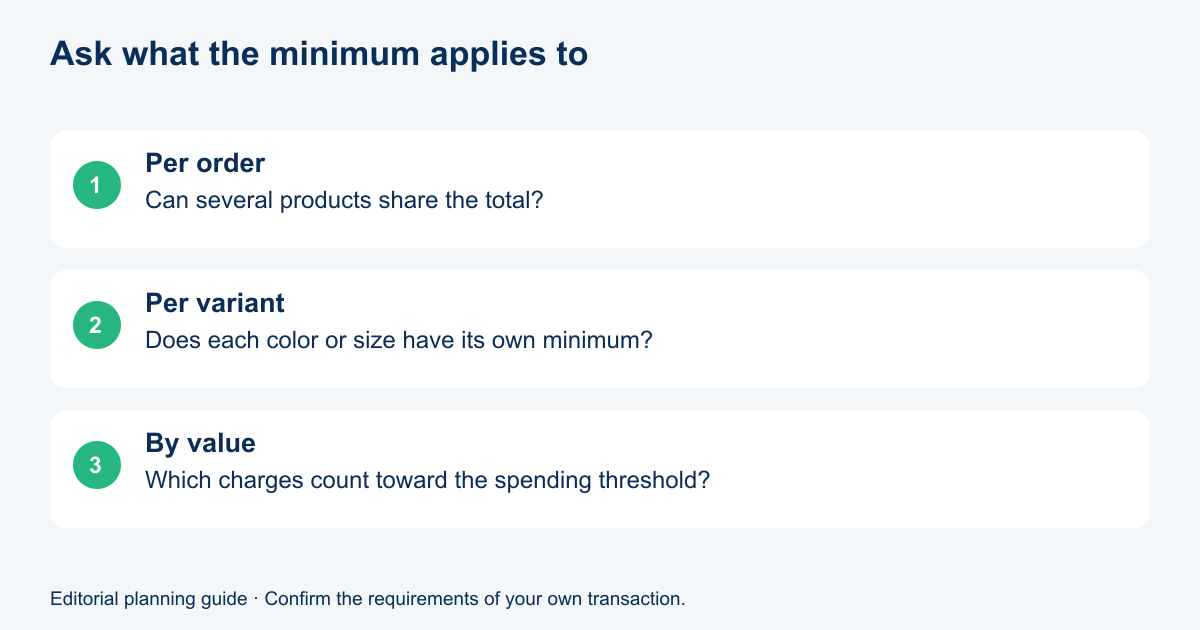
Ask whether it applies to the whole order, each product, each color, or each production run. A minimum order value is a related but different condition: it sets a spending threshold rather than a unit count.
Why do vendors set minimum quantities?
Production setup
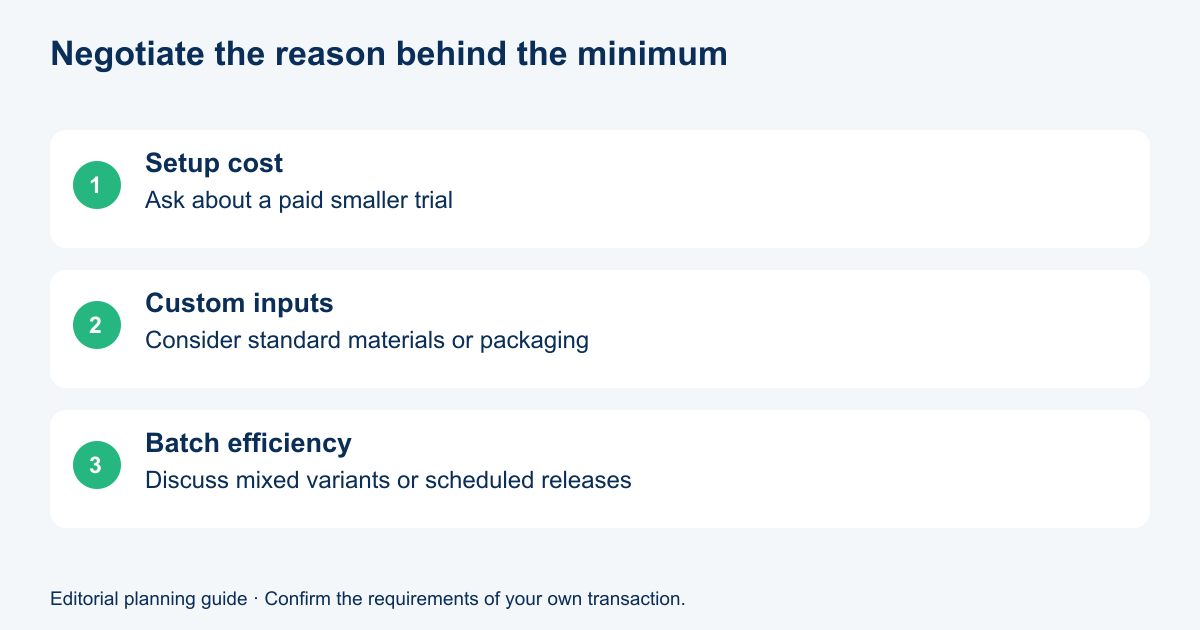
A factory may need to set up machines, mix materials, or prepare printing for a run. Spreading that work across more units can make the order commercially viable. Ask whether paying a separate setup charge would allow a smaller batch.
Material purchases
The factory may face its own minimum purchase for fabric, packaging, components, or other inputs. If your design requires a custom material, the constraint may sit with an upstream vendor. An existing material or standard component could change the calculation.
Packing and handling
Carton sizes, pallet quantities, and administrative work can influence the minimum. Confirm whether the quoted quantity is a production minimum or simply a preferred packing increment. The negotiation will be different in each case.
MOQ examples: what are you actually committing to?
One minimum across the order
Suppose the vendor accepts 1,000 units across several colors. You may be able to split that total among variants, subject to written agreement. That gives you a different stock position from ordering 1,000 of each color.
A minimum for each variant
If the minimum is 1,000 units per color and you want four colors, the commitment becomes 4,000 units. Ask the question before approving artwork or marketing a range that your budget cannot support.
A spending minimum
An order-value minimum of $5,000 could permit different combinations of products. Check whether shipping, tax, and setup charges count toward it. The answer belongs in the quote, rather than an assumption in your spreadsheet.
Calculate the full cash commitment
Multiply the required quantity by the unit price, then add costs you must pay to get saleable goods into stock. Include packaging, testing, freight, duties where applicable, storage, and any deposit for the next order.
For an illustrative purchase, 1,000 units at $8 each creates an $8,000 goods bill before those extras. At expected sales of 100 units a month, that quantity represents 10 months of demand if sales stay at that pace. The unit price may be attractive while the cash commitment is too large. Beyond the basic MOQ meaning, this is the number that determines whether the order fits your business.
Compare that exposure with your inventory turnover and the working capital needed between payments.

A smaller order with a higher unit price can still be a useful test. You are paying for less exposure while you learn what customers actually buy. Compare the total outcome rather than treating the lowest unit price as the only objective.
How to negotiate MOQ
Simplify the product
Ask about standard materials, existing packaging, fewer colors, or less customization. Keep the features your customer needs, then identify changes that reduce the factory's setup or purchasing burden. Confirm that any substitution still meets the agreed specification and applicable requirements.
Offer a paid trial run
Ask whether a higher unit price or separate setup fee would make a smaller initial order possible. Define how quality will be assessed and what happens if the sample or production batch fails. A trial works best when both sides know what a successful result would lead to.
Discuss scheduled releases carefully
A vendor may accept a larger production commitment with deliveries in stages. That can reduce the stock at your warehouse, but the full purchase obligation may remain. Agree on ownership, payment, storage, insurance, release deadlines, and cancellation rights.
Combine variants where practical
Ask whether the minimum can cover related products using the same material or production process. Do not assume mixed colors or sizes are acceptable. Put the approved mix on the purchase order and confirm that future replenishment follows the same rule.
By the numbers: compare two offers
An illustrative offer of 1,000 units at $8 requires $8,000 for the goods. A trial of 200 units at $10 requires $2,000. The larger order saves $2 per unit but commits an additional $6,000 before freight and other costs. Demand and margin determine which is more useful.
What should a buyer avoid promising?
Avoid guaranteeing future volume solely to obtain a lower minimum today. Forecasts can help a vendor plan, but a binding purchase commitment creates a real obligation. Separate your expected demand from the quantity you are agreeing to buy.
When discussing MOQ with vendors, review the contract and payment terms, including deposits and refunds. A refundable sample payment and a nonrefundable production deposit should not be treated as equivalent.
MOQ and EOQ serve different purposes
MOQ is a vendor's commercial condition. Economic order quantity is a planning calculation based on demand and ordering and holding costs. If your preferred order size is below the minimum, revisit the product, vendor, delivery structure, or purchase frequency.
For larger commitments, test the inventory funding plan under slower sales and delayed collections. Negotiating a minimum you can buy is only useful if you can also manage the resulting stock.
Plan vendor payments with Drip Capital
Drip Capital's Vendor Financing pays vendors directly and offers repayment terms of up to 90 days, subject to approval and terms. Evaluate it against the expected sales and collection cycle. Financing can help with payment timing; it does not reduce the minimum quantity or guarantee customer demand.
Frequently asked questions
Does a low MOQ always mean a better deal?
No. A lower quantity may come with a higher unit price or setup charge. Compare total purchase cost, expected sales, and cash exposure rather than the minimum alone.
Can I negotiate MOQ with every vendor?
Some vendors can change the minimum, while others face fixed production or material constraints. Ask what drives the requirement and propose a specific alternative. How to negotiate MOQ depends on the reason behind it.
Is MOQ the same as a carton quantity?
A carton quantity describes packaging. It may influence the order minimum, but the two are not automatically identical. Confirm both the minimum and the permitted order increments.