

Photo: CHUTTERSNAP / Unsplash. Illustrative container port in Singapore.. Illustrative image.
Canada buys far more from the US than finished products on store shelves. Its purchases also keep factories, construction projects, transport networks, and food businesses running.
So, what does Canada import from the US? The largest product sections include vehicles and parts, consumer goods, chemicals and plastics, and industrial machinery. For a US business, the useful next step is to identify the buyers and requirements within its own product category. A large national total does not by itself establish demand for your particular product.
What the ranking measures
The chart ranks the 10 largest goods product sections in Statistics Canada Table 12-10-0172-01, using 2025 Canadian imports from the United States on a customs basis. Values are Canadian dollars, rounded to billions. Special transactions trade is excluded from the product ranking.
This is a 2026 planning article using the latest completed calendar year, rather than a claim about full-year 2026 results. The categories follow Statistics Canada's North American Product Classification System. They are broad product sections, not individual products or a ranking of tariff codes.
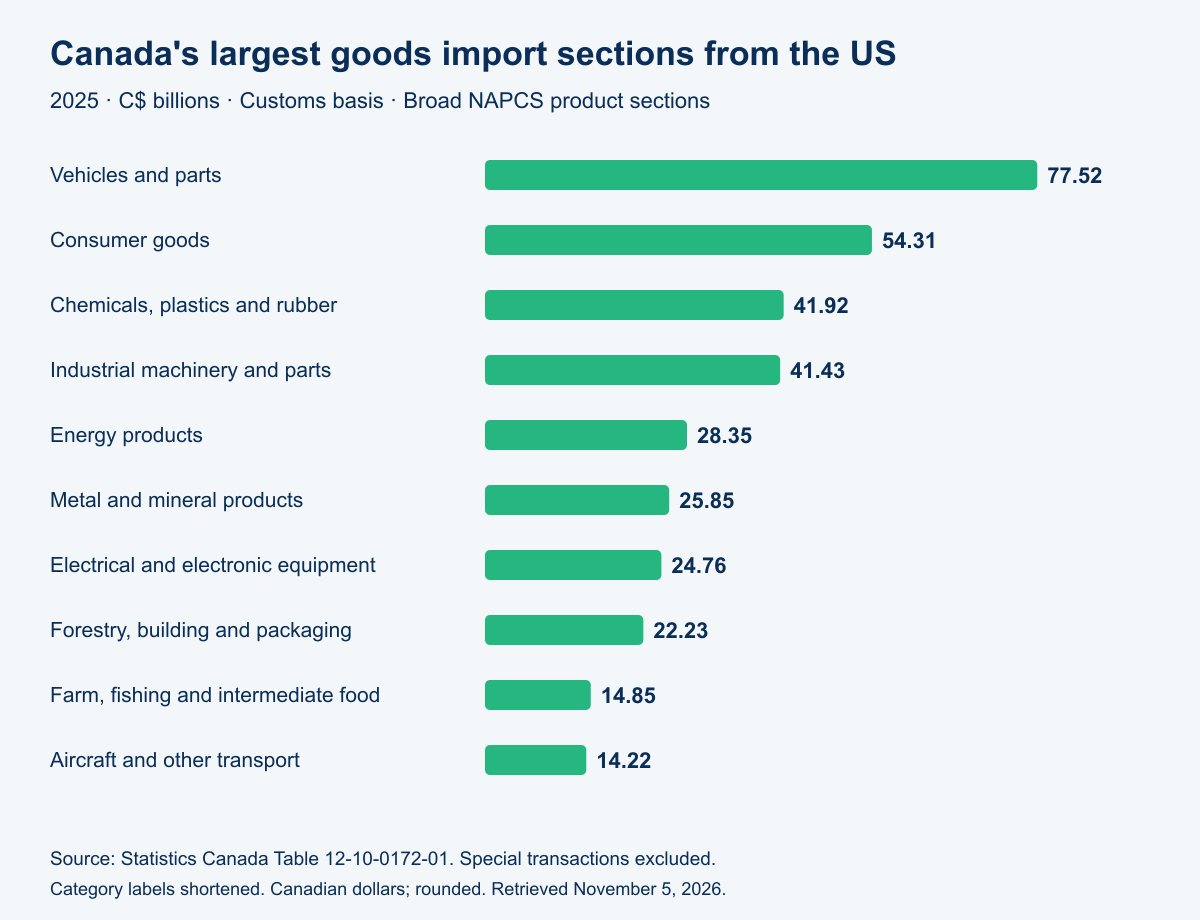
Canada's top 10 product imports from the US
1. Motor vehicles and parts
For an automotive business, the first distinction is finished vehicles versus parts and components. The ITA's Canadian automotive guide describes an established manufacturing and parts market with strong US connections.
Identify whether your buyer serves original-equipment production, repair, or the aftermarket. Product qualification, delivery schedules, and customer approvals can differ substantially across those channels.
2. Consumer goods
This broad section includes many categories with different routes to market. A grocery distributor, pharmacy buyer, and furniture retailer will have different requirements for packaging, delivery, and returns.
Narrow the opportunity to a specific customer and product. Ask who is responsible for Canadian labeling and regulatory requirements before approving a production run intended for that market.
3. Basic and industrial chemical, plastic, and rubber products
These purchases can support manufacturing and industrial operations. A business selling inputs should start with the customer's technical specification, handling requirements, and approval process.
Confirm the grade, packaging, documentation, and permitted substitutions. A buyer may need consistent production performance more than a lower spot price on a material it has never used.
4. Industrial machinery, equipment, and parts
Machinery sales often depend on installation, maintenance, training, and spare-parts availability. Ask how the Canadian customer will support the equipment after delivery.
Price those commitments before quoting. A profitable machine sale can become less attractive if the business has not allowed for service visits or urgent replacement parts.
5. Energy products
Energy trade includes different products and commercial arrangements. National totals do not tell a small business which transactions it can realistically enter.
Investigate the infrastructure, permits, product specifications, and counterparties required for the particular activity. Keep physical supply requirements separate from a general view on energy prices.
6. Metal and non-metallic mineral products
Buyers may need specific grades, dimensions, processing, or certification. Obtain the customer's acceptance criteria and traceability requirements before choosing the source.
Check current product-specific duties and measures with the Canadian importer or broker. A broad market category cannot establish the tariff treatment of a particular metal product.

Once you identify a promising category, build the transaction from the customer's requirements backward. That makes it easier to see which costs and responsibilities belong in your quote.
7. Electronic and electrical equipment and parts
Products can involve technical standards, compatibility, installation, and warranty support. Verify the exact model and intended use, especially where a US-market version differs from what a Canadian buyer needs.
Discuss stock availability and replacement arrangements. If the customer needs a continuing production input, one successful shipment is only the beginning of the relationship.
8. Forestry products and building and packaging materials
For building materials, project timing and product acceptance matter. For packaging, consistency and replenishment may be central to the buyer's production schedule.
Ask about order releases, storage, and damage claims. The cash required to hold stock for a customer can be significant even when delivery distances are manageable.
9. Farm, fishing, and intermediate food products
Food and agricultural products need a product-specific compliance review. The Canadian Food Inspection Agency's import guidance directs businesses to the relevant requirements and licensing information.
Confirm the Canadian importer's responsibilities, documentation, and any temperature or shelf-life constraints. Build inspection and delay scenarios into the delivery plan where relevant.
10. Aircraft and other transportation equipment and parts
In specialized transport markets, qualification and traceability can define who is able to sell. Ask the customer which technical, quality, and documentation requirements apply before committing to inventory.
Review US export controls as well as Canadian import requirements. A commercially available part may still need a transaction-specific export-control assessment.
By the numbers: understand the market's scale
The source table records approximately C$362.23 billion in Canada's 2025 goods imports from the US across all sections, including special transactions trade. The chart shows the relative size of the leading product sections. Values measure trade in money terms; they do not measure unit volumes or profit opportunities.
Do US goods automatically enter Canada duty-free?
Preferential treatment under the Canada–United States–Mexico Agreement depends on applicable origin and claim requirements. CBSA's CUSMA guidance is the starting point for the Canadian side. Shipping goods from a US warehouse does not by itself prove they qualify.
Have the importer or broker check the tariff classification, origin, current measures, and taxes for the shipment. Review export and import licensing and restricted-party screening alongside the tariff work.
What does the US import from Canada?
What does the US import from Canada is the reverse trade flow. It needs a separate dataset and ranking. Do not use Canadian purchases from the US as evidence of US purchases from Canada, or mix Canadian-dollar figures with US-dollar totals.
When researching Canada imports, keep the direction, year, currency, and classification visible. That simple discipline prevents a surprisingly common mistake in “top imports” lists.
Turn a market category into a workable order
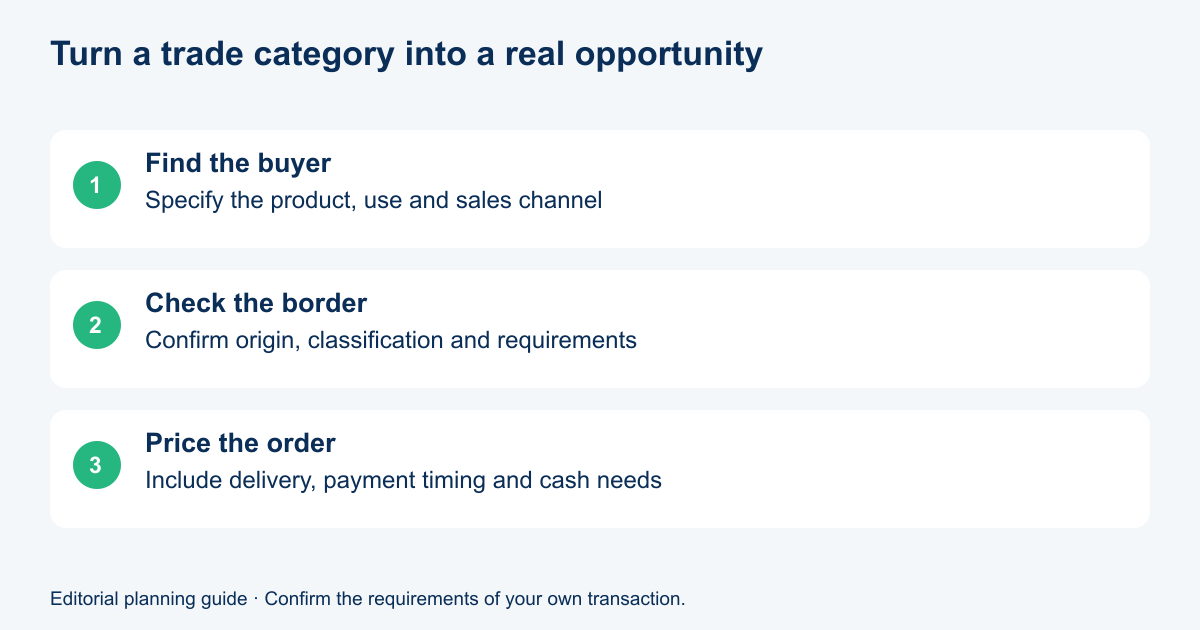
Answering what does Canada import from the US gives you a place to start. Use the top imports of Canada to narrow your research to a relevant category. Then verify the buyer, product requirements, delivered cost, payment method, and responsibility for border formalities. Put contract and payment terms in writing.
Map the time between paying for goods and collecting from the customer. Review your accounts receivable process before extending a large new credit commitment.
Plan vendor payments with Drip Capital
Drip Capital's Vendor Financing pays vendors directly, with repayment terms of up to 90 days, subject to approval and terms. Assess it against your specific purchase and collection cycle. Market size does not guarantee orders, financing approval, or timely customer payment.
Frequently asked questions
What is Canada's largest product import section from the US?
Motor vehicles and parts leads this ranking of 2025 customs-basis goods imports. The chart uses broad NAPCS product sections, so it should not be compared directly with a list of individual products or HS chapters.
Does this show all of Canada's imports?
No. It shows imports from the United States and ranks goods product sections. Canada's purchases from other countries and imports of services are outside this chart.
Are these 2026 full-year figures?
No. The article is for 2026 planning and uses completed-year 2025 data. Full-year 2026 results are not yet available as of this draft's November 5 review.